


Palma de Mallorca
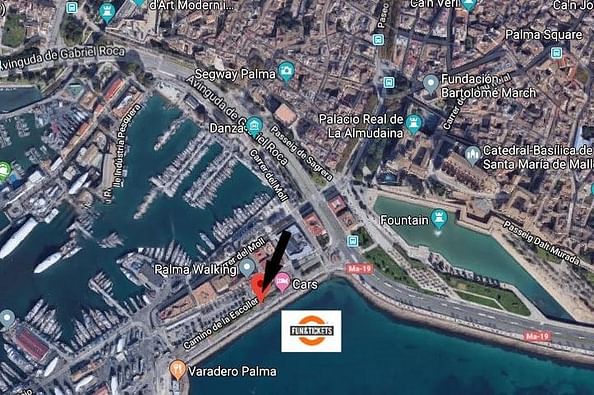
Palma was founded as a Roman camp upon the remains of a Talaiotic settlement. The city was subjected to several Vandal raids during the fall of the Western Roman Empire, then reconquered by the Bizantine Empire, then colonised by the Moors (who called it Medina Mayurqa) and, in the 13th century, by James I of Aragon.
Soller
Soller is a beautiful village located three kilometres from the Port on the North East coast of Mallorca and is known as the commercial and cultural centre on the Serra de Tramontana. It emerges from a valley surrounded by mountains called the ‘el valle de Los Naranjos’ (the valley of orange trees) and the beautiful, central square which is the main meeting point of the village, is surrounded by many small, cobbled streets. Upon our arrival in Sóller, the commercial and cultural center of the Sierra, we are greeted by the main square of Sóller, which is perfect for sitting on a terrace and observing the church of San Bartolomé and the Banco de Sóller building.
Port de Soller
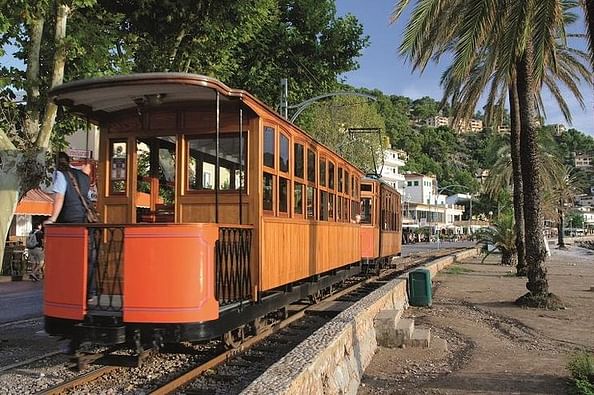
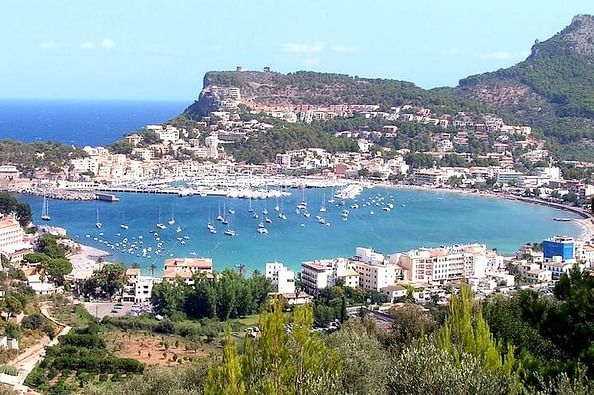
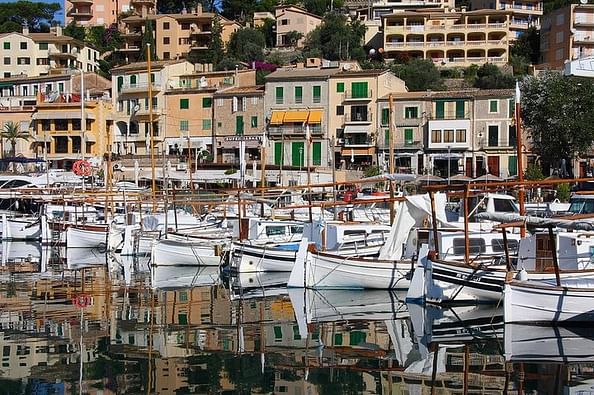
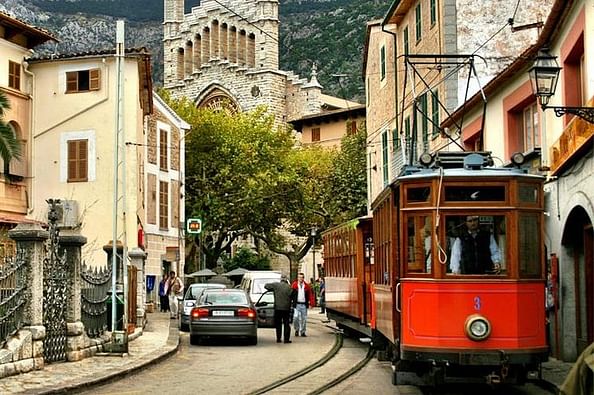
The Port of Sóller is a beautiful natural port located in the northwest of the island and an important center of tourist interest. A small treasure coveted in ancient times by privateers that offers us an unrepeatable landscape in which the smell of orange blossom mixes with the aroma of the sea. The port and the town of Sóller are connected by an old wooden tram that preserves all its aesthetics and original decoration and that we can admire while strolling along the lively promenade of the port.
Tram of Soller
On October 4, 1913, the first electric tram line in Mallorca was inaugurated, which ran between Sóller and Puerto de Sóller.
The construction of the Sóller tram began after the inauguration of the Palma-Sóller railway line. The project for this line was designed and directed by Pedro Garau, and 4,868 meters of track were laid. The iron bridge over the Torrent Major, built by the Terrestrial and Maritime Machinist, stands out.
Initially the tram had a power station located in the Sóller station. The station was powered by a 65 horsepower internal combustion engine that was powered by a Siemens-Schuckert dynamo, providing a direct current of 600 volts.
Although the Sóller tram was designed to transport passengers, it was also used to transport goods to the port. The fresh fish was transported from the Port to Sóller in a small isothermal car and the coal was transported to the old military submarine base in the Port of Sóller and to the “El Gas” factory in trailers; Mines and torpedoes from Caubet magazine were also transported.
The three motorized trams, numbered 1 to 3, and their trailers 5 and 6 are the originals, dating from 1912, commissioned from Carde & Escoriaza in Zaragoza. The ‘planter’ open trailers were acquired from Palma’s trams in 1954.
The Sóller tram also has five motorized trams from Lisbon, numbered 20-24 and calibrated to suit the 914mm track gauge.


